

How much? Calculating Daily Protein Intake
Daily protein intake requirements can be tricky at best, given an individual’s variables when it comes to size, sex, activity, body composition, metabolism, etc., but not impossible. Here is our intake guide.
Other, quick access guides to get you started:
- How many protein shakes should I use (Simple guide)
- How many bags of protein do I need per month (Simple guide)
- Benefits of protein, and why you need it.
Below is a more comprehensive approach to calculating your daily protein needs.
RECOMMENDED DAILY PROTEIN INTAKE
The Recommended Daily Intake (RDI) is:
- AU: 0.84g per kilogram body weight.
-
USA: Recently updated - 1.2 - 1.6 g per kilogram body weight
So, for example, if you are 100 kgs in weight. The Australian guideline, which hasn't been updated for some time, and is a minimum, or RDI, is 84 grams of protein per day. (100 kg x 0.84 = 84 g).
If you are following the US's more recent guidelines, the intake would be 120-160 g of protein per day.
Note: This doesn't take into account several individual variables, a key one being exercise, as well as the % protein in your food or protein powder. If you believe protein intake is not a one-size-fits-all, then read on.
Keep in mid this total includes protein from meals as well.
DAILY PROTEIN INTAKE TABLE
To get a more accurate read on how much protein you need, first understand your daily protein intake requirements. Start with your base need, then consider additional requirements resulting from exercise or calories burnt, as well as age, etc.
With this in mind, we couldn't find a guide that accounted for additional requirements, so we developed one. It has some assumptions, yes, but it is based on research and expert input.
Quick user guide:
- Scroll down to the table below.
- If you don't exercise, find your weight in the left-hand column. The amount of protein is included in the Base column is based on the Australian RDI or minimum daily requirement
- If you exercise, move to the right in the top row to the corresponding number of calories you burn as a result of exercise. Drop down this column to your weight, and that will indicate how much protein you need.
(For example, if you weigh 100kg and burn about 1,000 calories from exercise, you will need approximately 134 grams of protein).
Be sure to read the assumptions and guidance after the table:
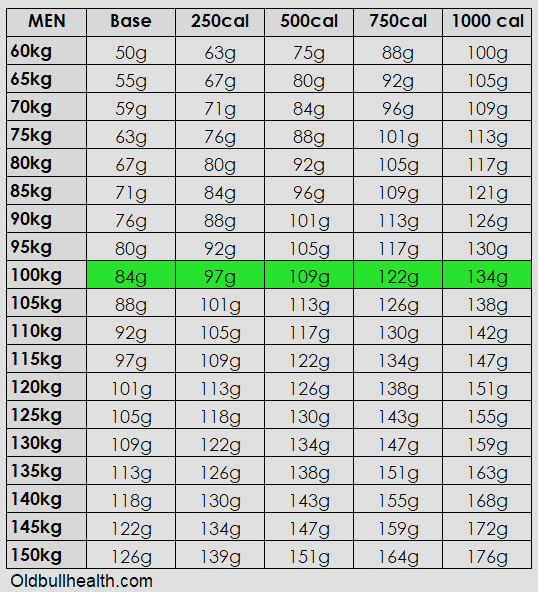
Assumptions:
- 1g of protein is 4 calories, and the protein content from calories is 20%. (The average based on various research papers). Australia and New Zealand nutrient reference values and guidelines quote a minimum of 10% and a maximum of 35%.
- Body composition is not taken into account in the above, individual circumstances or health conditions, so talk to a health professional before changing your diet.
- Protein intake for women is here
TO CALCULATE YOU WILL NEED:
1. Working out your daily calories
We all burn a certain number of calories every day, regardless of how active we are. The more active you are, the more calories you burn.
If you don’t have an Apple or Garmin smart watch to tell you how many calories you are burning while you exercise, we have included some guidance below to help you figure this out.
2. Estimating calories burnt
How many calories a day does a "normal" person burn?
WebMD has created a useful table here, which shows the estimated calories for males 50+ to physical energy balance are as follows:
- Sedentary 50+ male: 2000 calories p/day
- Moderately active 50+ male: 2,200-2,400 calories p/day
- Active 50+ male: 2400-2800 calories p/day
You can also estimate your actual base with the following handy calculator to calculate your BMR (Basal Metabolic Rate) and then compare it to the above, which is based on a standard recognised formula (Just fill in the missing):
(66.47 + (13.75 x weight in kg) + 5.003 x height in cm) – (6.755 x age in years)
(This is called the Harris-Benedict Equation originally published in 1919 and revised over the years, and most recently in 1990 by Mifflin and St Jeor)
Again, this is a guideline as it doesn’t take into account body composition and those of you who are more research-orientated will also notice the constants in the formula can vary, the formula above however is the original.
Now, by comparing the two results above, you know how many calories you are burning and can factor this in with your exercise- or activity-based calories, per the table.
Simple example using the above:
Moderately active male per table 2,200
Using the BMR calculator tool 2,300
Additional calories +100
Calories burnt from exercise +650
Total additional calories burnt per day +750
From an exercise perspective, again, there are variables based on time, heart rate, fitness, etc. On average, a 100kg male of average fitness running 5 km in around 27-30 mins will burn around 500-600 calories.
CURRENT PROTEIN INTAKE
To work out how much protein you consume in a day, there are a number of apps that can track it. Myfitnesspal is one of them, if you don't already have one. But you need to fill in a food diary.
Or just use the calorie calculation above and our protein intake table, using your weight and the average daily calories burnt to get a more informed guideline.
PROTEIN POWDER SUPPLEMENTS
If you already use a protein powder, it probably has a 30 g scoop like ours, and the ingredients panel will show you how many grams of protein there are in that 30 g serve.
Now, before you get the protein powder and scoop out 30 g into multiple smoothies, note that this is the total protein you need, which includes dietary protein, i.e., protein in the foods you consume at each meal. They shouldn't replace a solid, balanced diet. diet.
Protein supplements work well in conjunction with resistance training, outside of meal times. They can also be used as a meal replacement to help avoid morning or afternoon hunger cravings.
NUTRITION CHOICES
French Fries
Your challenge is managing the carb and fat intake alongside this protein. So, for example, 100g of French fries has 3.4 g of protein. Probably not a good idea to eat 3.3 kg of French fries to get your protein intake.
Alcohol
On this matter, for your information, whiskey has no calories; red wine has 0.1 g per serving, meaning you would need 11,200 servings, or around 4,480 glasses, to meet your RDI for protein. If you did pursue these options beer is your best bet with 0.5 g per serving or around 840 beers, but definitely not something we would recommend!
DAILY NEEDS
You should now have a reasonable idea of your daily protein needs, and also how much protein you get from the food you consume.
If you have a protein gap, protein powder is a great supplement just before or after exercise. If a protein supplement is a change to your regular diet, please consult with a health professional first.